Read most any description of the now-burgeoning genre known as folk horror and the first reference points you’re likely to be given will be three films released within a half decade of one another: Witchfinder General (aka The Conqueror Worm, 1968), Blood on Satan’s Claw (1971), and The Wicker Man (1973). These films are indeed a perfect place to begin any exploration of the topic. Each of them at root deals with a fear of the survival (or the revival) of pre-Christian beliefs and practices. I would go so far as to argue that this fear is also a mask for a deeper fear: that of the abandonment of Christian sexual taboos in favor of a more natural view of sexuality. These films appeared just as the sexual revolution was beginning to fully integrate itself into mainstream culture and could be viewed as a response to those changes. But this is just a starting point. Other themes these films exhibit can be phrased in sets of binaries: pagan vs. Christian, traditional vs. modern or progressive, local vs. national, or rural vs. urban. It is within the first element of these binaries, the traditional, the local, the rural, and the pagan in which the mystery and the horror lies.
There were earlier films that are often seen as precursors to those mentioned above, Jacques Tourneur’s Curse of the Demon (aka Night of the Demon, 1957) for instance, and many others have been made since The Wicker Man debuted in 1973. It would be wrong to think that folk horror is entirely a cinematic genre, however. Two of the “unholy trio” of films above started life as novels and the mass market literature of the 60s and 70s is filled with many other examples of folk horror gems. It is probably in television, however, that folk horror experienced its fullest flowering. This occurred not only by giving the above-mentioned films a much wider visibility through late night airings, but via original programming as well, much of it intended for younger audiences.
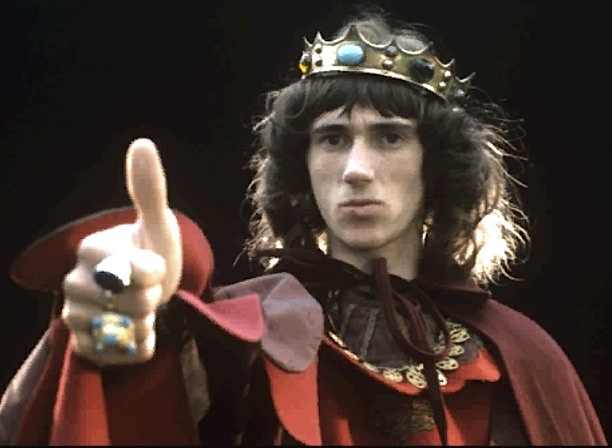
Phil Daniels in Raven.
I’ve been aware of folk horror for many years, although I never had a name for it until the A Fiend in the Furrows conference was held in Belfast in 2014. Before that, I simply saw it as an aspect of the folkier end of hauntology. Hauntology is a television-obsessed area and it was through my own hauntological explorations, revisiting and discovering long forgotten TV shows of the 60s and 70s—like Children of the Stones and the almost totally unremembered Raven, both from 1977—that I first started thinking of folk horror as a category. I still had no name for it, I just knew that I was attracted to this supernatural and mysterious material that drew on rural and folkloric themes. I wasn’t the only one thinking along these lines, though, and when the announcement for A Fiend in the Furrows appeared, it felt as if something whose time was long overdue had finally arrived.
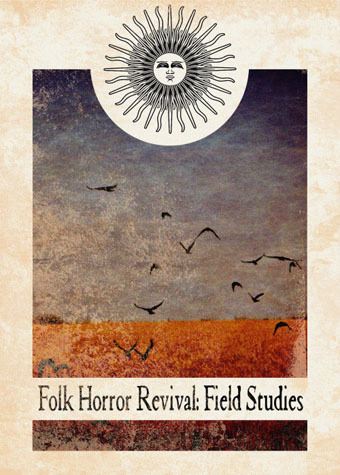
The recent appearance of Folk Horror Revival: Field Studies edited by Katherine Beem and Andy Paciorek (see below for details) reinforces the idea that television was a huge force in the development of the genre. Gray Malkin’s “Public Information Films: Play Safe,” Andy Paciorek’s “Albion’s Children: The Golden Age of British Supernatural Youth Drama,” and Adam Scovell’s articles on Nigel Kneale all explore various aspects of the genre’s manifestation on TV. Throughout the book, even in articles about music, art, or cinema, television is present as influence or subtext. My own piece in the book, “Folklore and the River: A Reflection on Davis Grubb’s The Night of the Hunter,” exists because many years ago I saw Charles Laughton’s film version on television, which led to my interest in the original novel. For me, folk horror still sits firmly at the folkloric end of hauntology and will be forever associated with a certain aesthetic, a certain feel, that was occasionally captured so perfectly on television in the 60s and 70s. I see this as its source, however, and not as a limiting factor. Folk horror is still a living genre with a veritable labyrinth of angles to be explored, as Folk Horror Revival: Field Studies makes evident.
Folk Horror Revival: Field Studies can be ordered here.
100% off all profits will be donated to projects run by The Wildlife Trusts.
—Stephen Canner
 Liminal Cultures