Future Tense: London Writers and 1990 as Year Zero

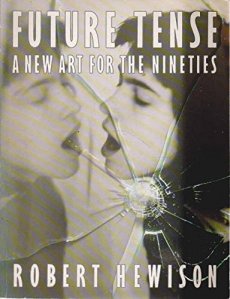
“The end of a millennium promises apocalypse and revelation. But at the close of the twentieth century the golden age seems behind us, not ahead. The endgame of the 1990s promises neither nirvana nor Armageddon, but entropy.” In Robert Hewison’s Future Tense: A New Art for the Nineties, published in 1990, he paints a world in which the avant-garde has been fetishized and commodified until it has been stripped of all relevance. He describes a cultural stagnation that he associates with postmodernism, and in so doing anticipates Mark Fisher’s ideas of “lost futures” by nearly a quarter century, although both drew heavily on the foundational work of Frederic Jameson in this area.

Hewison does not believe that all is lost, however. In Future Tense he surveys a number of artists and writers who were actively bucking the negative inertia of the time in an attempt to “break through the screen of cultural conservatism and commercial Philistinism to challenge official values and offer a passionate vision of future possibilities.” In a contemporary review of the book for The Observer, Mik Flood states that Hewison’s focus is on those who “have been burnt out, wiped out, priced out or sucked out by the hegemonic monoculture of the corporate marketplace.” Hewison does not limit his study to the plastic arts, but includes actors, performance artists, architects, and writers. To explore British literature’s response to this cultural malaise, he discusses three novels: Peter Ackroyd’s Hawksmoor (1985), Iain Sinclair’s White Chappell: Scarlet Tracings (1987), and Michael Moorcock’s Mother London (1988).

To me there is something prescient about choosing to focus on these three novelists as a group as early as 1990. Ackroyd and Sinclair were poets who had only been writing fiction for a very short time. There was not yet much, if any, buzz about the shared themes that these writers are now known for, which often seems to boil down to history and antiquarianism practiced as an occult art. Most strikingly, in his introduction Hewison states that he has used these three novels, along with the London scenes from Salman Rushdie’s The Satanic Verses, “to evoke an idea of the city—what the Situationists called a ‘psychogeography’—that is more profound than planners’ plot ratios.” This is certainly one of the earliest associations of psychogeography with these London writers to ever appear in print.
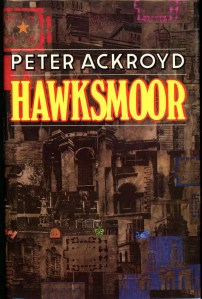
Although all three of these novels take place in and around London, what they share at a deeper level is a unique vision of time and how it functions. In Hawksmoor, Peter Ackroyd replaces the historical architect Nicholas Hawksmoor—who flourished in the early 18th century and is best known for the six London churches he designed—with the fictional Nicholas Dyer, a worshipper of Satan with some very unorthodox ideas about architecture. Hawksmoor himself is transmuted into a 20th-century detective charged with solving a series of murders that have occurred near each of Dyer’s churches. The connections and interactions between the two narratives, separated by nearly 300 years in time, drive the plot.

Ackroyd borrowed—or stole, depending on your point of view— the idea of occult associations with Nicholas Hawksmoor’s designs directly from Iain Sinclair’s 1975 poetic work Lud Heat. In a 1996 article in the London Review of Books, Sinclair describes Ackroyd in a sort of sideways compliment as “an unparalleled library vampire, a gutter and filleter of texts, a master of synthesis.” Hewison’s analysis of Sinclair’s first novel, White Chappell: Scarlet Tracings goes deep. He calls it “a multi-layered scrapheap of literary, historical and autobiographical references, where characters move back and forth in time, and narrative is broken and collaged into a pattern that matches the dissociated experience of the twentieth-century narrator, yet nonetheless is directed towards a transcendental unity.”
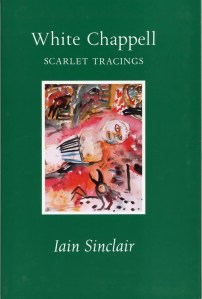
Time, not geography, again becomes the most important element in Hewison’s discussion of the novel. To highlight this aspect, he quotes from the text at some length: “We have got to imagine some stupendous whole wherein all that has ever come into being or will come co-exists. . . . So it’s all there in the breath of the stones. There is a geology of time! We can take the bricks into our hands: as we grasp them, we enter it. The dead moment only as we live it now. No shadows across the landscape of the past—we have what is coming: we arrive at what was, and we make it now.”

Already, at this early date, Hewison seems to deeply understand Sinclair’s approach: “The invitation is to decipher White Chappell, Scarlet Tracings as a prophetic text: its construction suggests further breakdown and dislocation, but it also shows that the experience of the city cannot be limited to the present, nor can the past be confined to museums. The ‘geology of time’ is such that, if we will allow them, the resonances of the past can inform contemporary existence without having to be turned into the simulacra of tourism.” This quote also evinces an understanding of Sinclair’s methodology that would inform his later non-fiction, but would not become well known until the publication of Lights Out for the Territory: 9 Excursions in the Secret History of London in 1997.

In both White Chappell: Scarlet Tracings and in Michael Moorcock’s Mother London, the “city becomes a form of collective unconscious” according to Hewison. The latter novel’s cast of characters is made up of a group of outpatients from a mental hospital, all having suffered various traumas during the Blitz. The narrative “moves forward and back in time between 1940 and the 1980s, weaving a pattern of experience and memory that presents an image of London’s deep imaginative resources.” It includes a character named David Mummery who has written a book called London’s Hidden Burial Grounds and is working on a new one on the city’s “lost” tube lines. While researching this new book, he discovers that “there are, too, older tunnels, begun for a variety of reasons, some of which run under the river, some of which form passages between buildings. . . . Others had hinted at a London under London in a variety of texts from as far back as Chaucer.” Setting aside the fact that Richard Trench and Ellis Hillman’s London Under London: A Subterranean Guide had already appeared in 1984, it would not be unreasonable to suggest that Moorcock just may have had his friend Iain Sinclair in mind when developing this character.

Hewison ends this section of the book by stating, “These novels depict the city ‘visible but unseen’ of Salman Rushdie’s The Satanic Verses. But to reveal the many layers, the psychic archaeology of the city, it is necessary to abandon mere surface realism. Time has to be presented free of conventional perspective, the present of every moment is disrupted by the knowledge of, even intervention by other moments. Narrative is as fragmentary as experience, and mysteries are not explained.”
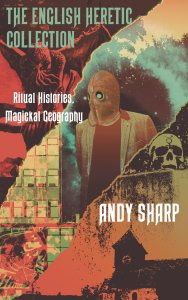
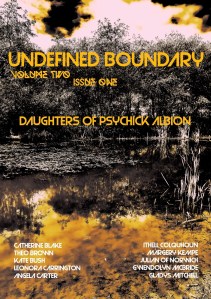
This idea of “psychic archaeology” feels to me like the perfect term to describe the approach of many of those 21st-century writers and artists who have been heavily influenced, directly or indirectly, by the early work of Ackroyd, Sinclair, and Moorcock. As examples, I think of the authors who appear in Undefined Boundary: The Journal of Psychick Albion or Andy Sharp and his English Heretic project. And like Hewison’s trio of London writers, those within this contemporary milieu are usually content to let the mysteries remain. There is no attempt to “solve” the world around us. There are simply suggestions as to how one might view reality with a different filter.

The concept of “London writers” that emerged around 1990 created an easily understood label around which their shared influences could congeal. At this early date Iain Sinclair was just beginning his transformation from avant-garde poet and book dealer into the Wizard of Hackney. His method of engaging with “mundane” reality as something almost magical would inform an entire subgenre of writing in the 21stcentury, one that would effectively become its own intellectual subculture. Acting as something of an alchemical reagent to allow this subculture to begin to grow in earnest, the newsletters of the London Psychogeographical Association first appeared in 1993, drawing heavily on Sinclair’s work. While parodying the “Grand Narrative” approach that characterizes much pseudoscientific writing from the fringes, they created a model in which the occult, history, landscape, popular archaeology, political hegemony, and the effects of capitalism could be easily connected, providing something of a subliminal blueprint for many writers who were to follow.
The timing of Hewison’s book is important. Although many of its intellectual sources can be traced further back, the current 21st-century experimental cultural climate in which the importance of liminality, landscape, folklore, and the idea of occulted history are dominant themes first appeared as something recognizable around 1990. It emerged at the place where avant-garde poetry and art intersected with anarchist and Situationist ideas, often expressed in the language of the occult. In those early days it carried no easy labels, so researching its origins more deeply will likely require an adoption of its own methodology, looking for the traces, the resonances, the “psychic heat” its practitioners left behind them.

—Stephen Canner
A Thousand Little Poets: Dreaming a New Mythology

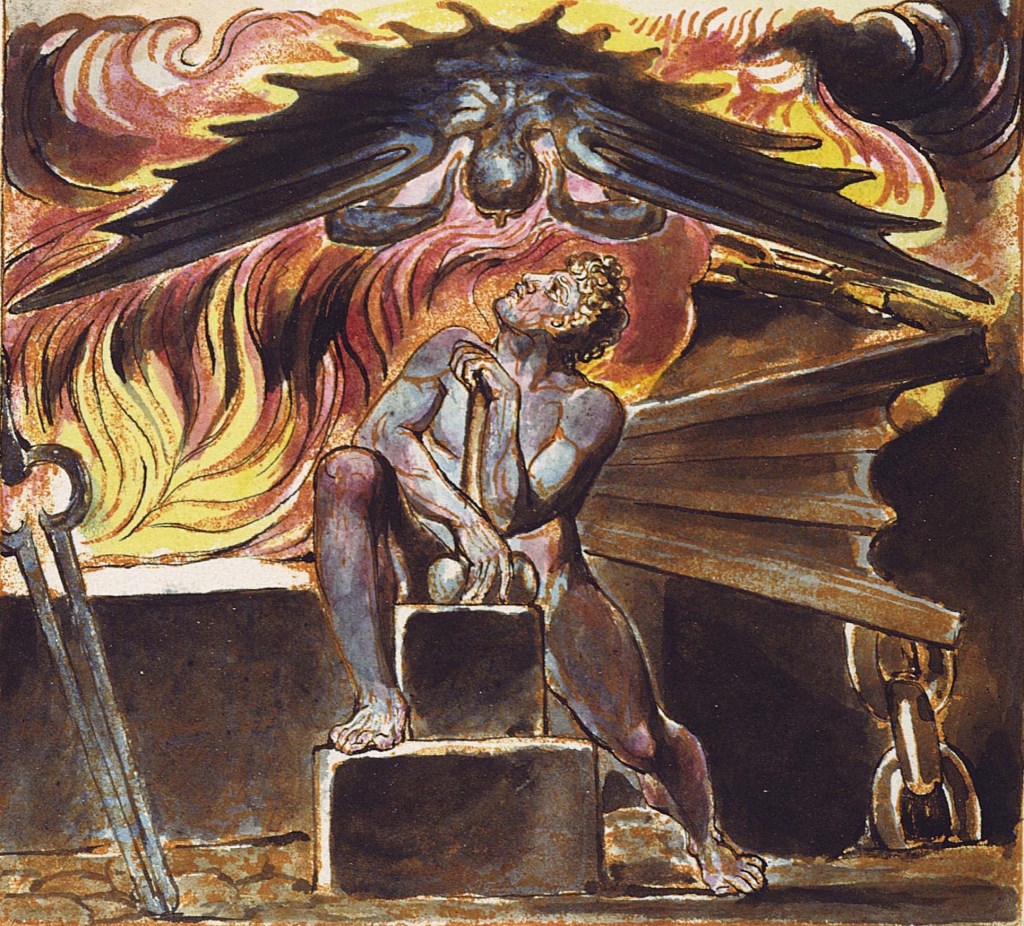
Spectre Over Los. William Blake. From Jerusalem, 1821.

Since the beginning of the 21st century, a flurry of cultural activity has emerged from a certain location on the borderlands of the intellectual landscape. Its points of view are fueled by a distinctly blurred range of influences. These include psychogeography and hauntology, with the occasional influx of Situationist or surrealist sympathies. Although approached from radically different angles, the works created by those operating within this zone—whether literary, cinematic, visual, or musical—tend to fluctuate between the twin poles of fascination with the urban on the one hand and the rural and folkloric on the other, ultimately resolving within the liminal space that lies between the two. But it is within that liminal space—in which brutalist architecture, beat poetry, public information films, ancient village traditions, forgotten library LPs, surrealism, standing stones, 1970s children’s television, pulp paperbacks, and obscure figures from the history of the occult are all treated with equal weight and reverence—that the zeitgeist truly reveals itself. 

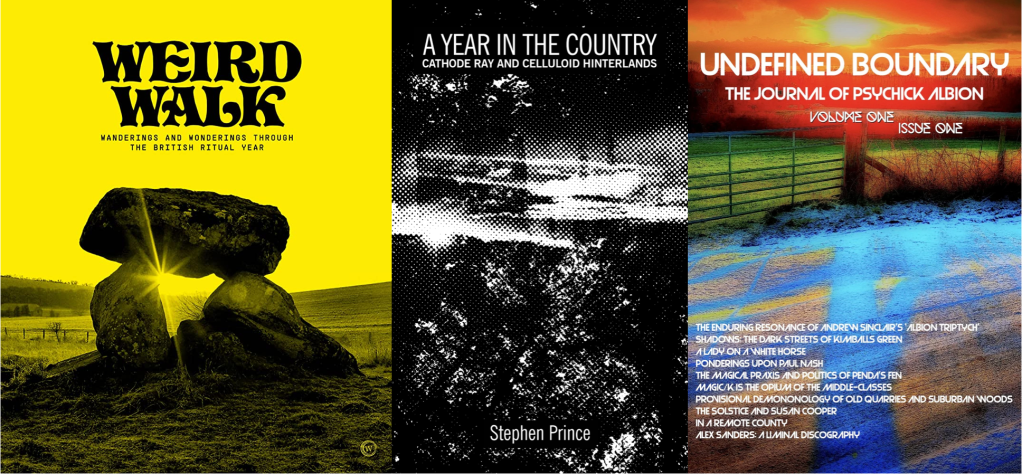
This is a trend that defies easy labels, with most activity being found in the blogosphere and in DIY releases. It finds its voice in zines like Weird Walk, blogs like Stephen Prince’s A Year in the Country, and the output of small publishers like Wyrd Harvest Press or Cormac Pentecost’s Temporal Boundary Press. But what is the point of all this enthusiasm for the forgotten corners of landscape, microhistory, and popular culture? The participants in this milieu are all engaged at some level in poiesis: a creative process, an action that can transform how we see reality. Often present in their works is the attempt to uncover hidden meanings and occulted connections in the otherwise mundane. At times these exercises in avant-garde antiquarianism, hermeneutical urban planning, and occultural archaeology feel like nothing short of an attempt to create a new mythology.

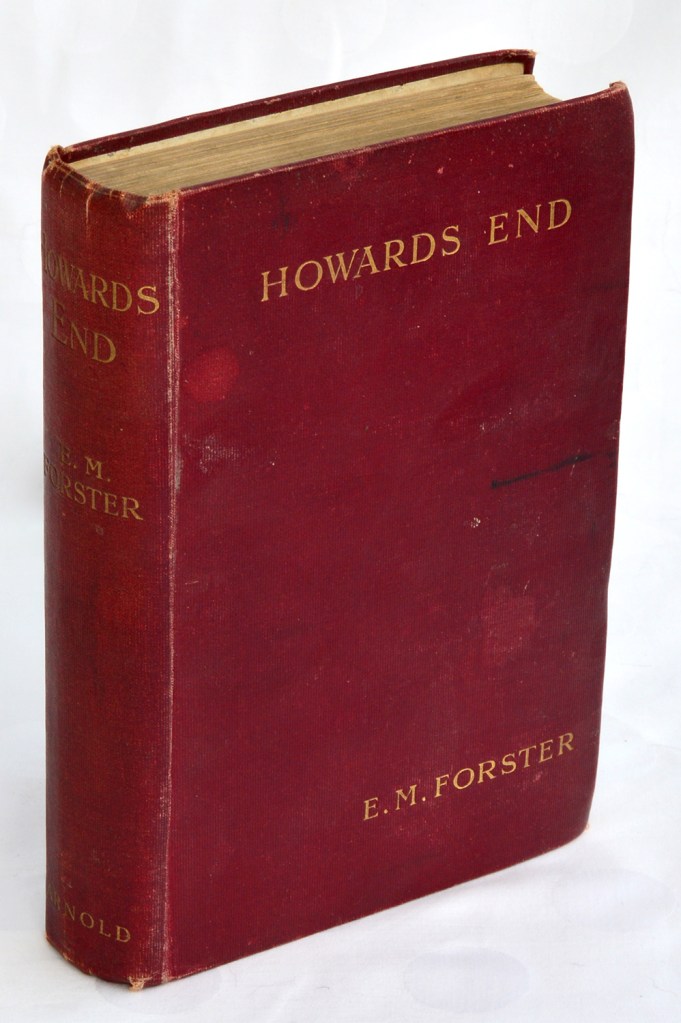
In E. M. Forster’s 1910 novel Howards End there is a scene in which a character begins musing on local legends and their larger meaning while walking across a village green in rural Hertfordshire:

“Why has not England a great mythology? Our folklore has never advanced beyond daintiness, and the greater melodies about our countryside have all issued through the pipes of Greece. Deep and true as the native imagination can be, it seems to have failed here. It has stopped with the witches and the fairies. It cannot vivify one fraction of a summer field, or give names to half a dozen stars. England still waits for the supreme moment of her literature—for the great poet who shall voice her, or better still for the thousand little poets whose voices shall pass into our common talk.”

The character is named Margaret Schlegel. Although educated and well read, she seems to have missed that England’s great poet, the “supreme moment of her literature,” may well have already arrived a century before, in the form of William Blake. Although still sometimes cast as a madman at the time, by 1910 Blake had been rediscovered and a reappreciation of his life and work was in full flower. Also that year, a veritable army of folklorists had already for decades been delving deeply into the island’s folk culture in an attempt to unveil and document England’s “great mythology,” finding it anything but “dainty.” The collected publications of scholars like Alfred Nutt, Jessie L. Weston, and Sir James George Frazer suggested that Britain very much had its own rich mythology that went far beyond nursery tales of enchanted woodlands. Perhaps, though, she had in mind something less fragmented, something that could be served up readymade: a national myth cycle like Finland’s Kalevala or Wagner’s crafting of the Ring cycle into a mythology that a newly-unified Germany could claim as its own.

Despite these apparent blind spots, Margaret’s call for a “thousand little poets” seems almost prophetic, perfectly capturing the creative landscape of the early 21st century in which scores of inventive minds strive diligently, if somewhat obliquely, towards reworking a moribund mythology into something both ethical and relevant to modern society—a new mythology that deals not only with witches and fairies, but also with capitalism, class, identity, and race. Although this trend began in Britain and a number of its threads are decidedly Anglocentric, many of these modern creative minds are no longer content to simply solve the Problem of England—to borrow a phrase from Patrick Keiller—but seem to be seeking new ways to frame the Problem of Modern Existence at its most fundamental level.

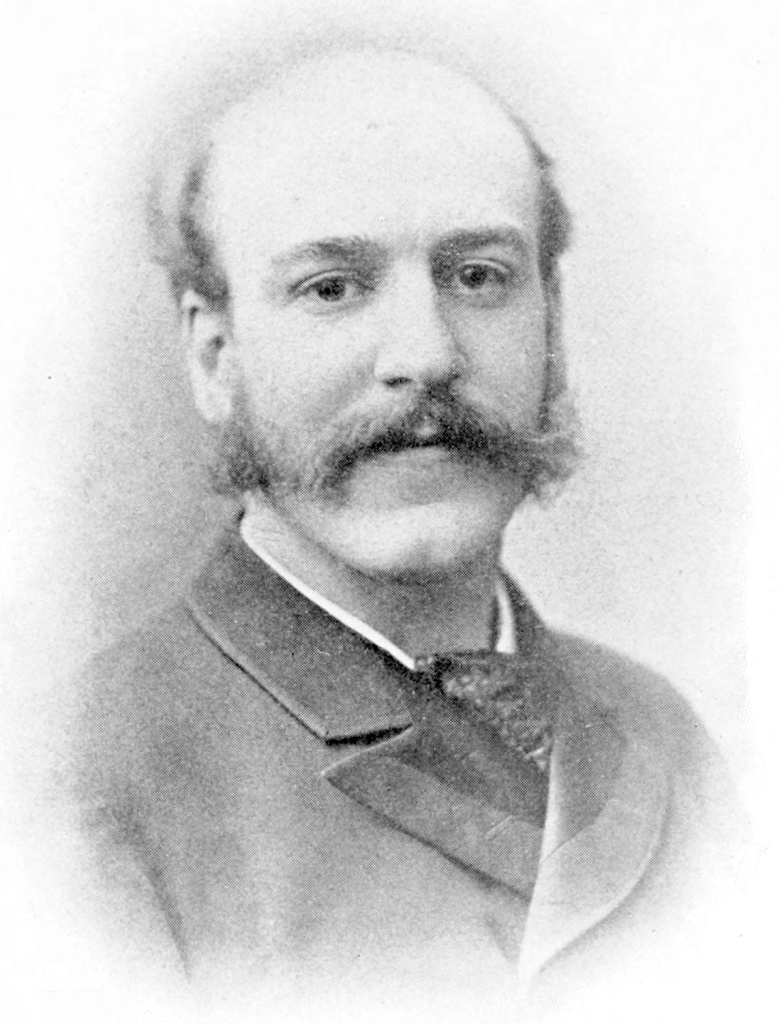
Alfred Nutt: Folklorist, Celticist, and president of the Folklore Society.

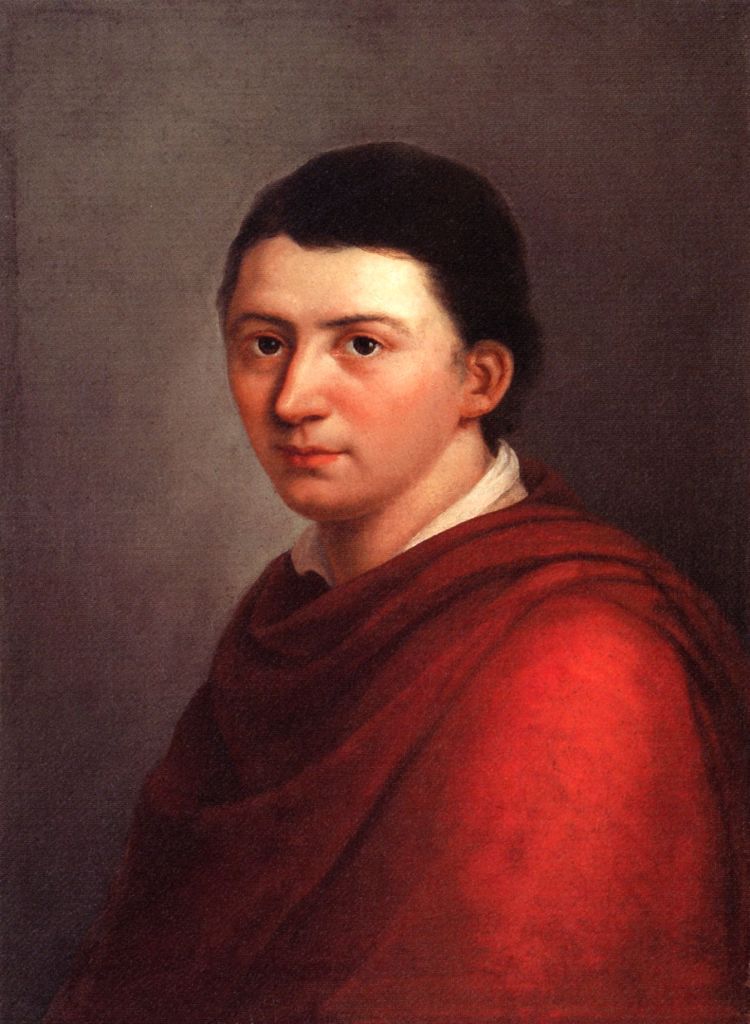
Although Margaret Schlegel and her siblings were portrayed in Forster’s novel as being “English to the backbone,” their father was German. He was said to have “belonged to a type that was more prominent in Germany fifty years ago than now. . . .If one classed him at all it would be as the countryman of Hegel and Kant, as the idealist, inclined to be dreamy, whose Imperialism was the Imperialism of the air.” Forster’s choice of surname for this family was unlikely to have been an accident. At the beginning of the 19th century, the very same moment that Blake was delivering his own half-mad vision to the world, the German romantic philosopher Friedrich Schlegel was calling for the creation of a new mythology, one that would unlock humankind’s “divinatory power.” In his article “Filling the Black(w)hole: The Call for a New Mythology by the German Romantics and Its Reach into the Digital Age,” scholar Nathan Bates asks, “But how could such a mythology be created?” He answers this by saying that “a solution would be best achieved, according to Schlegel, by individual creative efforts.” 

Portrait of Friedrich Schlegel. Franz Gereis, 1801.

Of course, what is meant here by mythology is not simply fairy stories, but something closer to Joseph Campbell’s concept of myth as the ongoing search for “the experience of life.” This is the very thing that has occupied philosophers, psychologists, and theologians for millennia, the search for those fundamental elements within our psychic depths that serve as anchor and fulcrum in the creation of our metaphysics, our cosmology. Myth is the form those elements take when they cross the proscenium from the abstracted world of the subconscious and emerge into the part of the mind that engages with the physical world. From there they reveal themselves—subtly, often unrecognizably—translated into cultural expression. This expression includes the whole gamut of human endeavor: art, architecture, music, literature, cartography, design, urban planning, and much more, in both their “high” and vernacular forms. 

The most exemplary contemporary expression of this tendency in both its breadth and depth is perhaps Undefined Boundary: The Journal of Psychick Albion, the latest imprint from Temporal Boundary Press. In the introduction to the second issue, editor and founder Cormac Pentecost writes: “The defining feature of all things Psychick Albion is the question of whether reality contains something more than we suspect. Artists of all persuasions are intimately in touch with this question because their work involves imagination and creativity; they are working to bring new worlds into being. . . .There is a tacit agreement between writer and reader that we will allow the possibility of this other reality to hang in the air, perhaps as an illusory image of something eternally true, perhaps as a simple fiction, but in any case as a possibility. This is the key: not to interrogate the ontological status of this other state of being, but to explore it for the lessons it can bring us about how to most creatively live our lives.” 

In his essay “A Lady on a White Horse” in the first issue of the journal, Nigel Wilson explores the folklore surrounding this figure, through her pagan, Roman, and Christian-era manifestations. He closes his piece by casting the modern era as one in which it has “become difficult to dream.” The current era is one in which “the emphasis is for leaders, preferably a strong authoritative one who is beyond contradiction; a person to whom we are all subordinate: the hero, the genius, the Great Leader. Let us call this the Age of the Father.” He then goes on to reject this worldview and to make a statement that could easily be interpreted as a call for a new mythology: “. . . but let us also be aware that this age may now be approaching the point where such stern figures have become redundant to human need for the simple reason that they don’t make sense anymore. What is required is more cooperation, more collective decision making.” 

In the journal’s second issue, in his article “The Spectre of Trauma in the Myth of Psychick Albion,” George Parr is even more specific in his call for a new paradigm: “The suggestion then, is that through piecing together these lost threads we might find an alternative Britain in which the pastoral alchemy and gothic psychedelia of the island’s rich and diverse countryside may no longer be a quaint trend subtly running through our traditions and art, but at the very forefront of our culture. A Britain where Tory aristocracy is not the norm, where the spirit of anarchic magic and rebellious art are the guiding principles—a Psychick Albion in place of a Great Britain.”

In responding naturally to the various fascinations that propel them along their various trajectories, the collective work of these “thousand little poets” reveals that whatever vestiges of traditional myth remain in Anglophone cultures are often woefully inadequate for the spiritual, intellectual, and material circumstances in which we now find ourselves. To be clear, I don’t mean to imply that this search for a new mythology is necessarily a conscious pursuit. As Joseph Campbell stated in his famous 1988 television interview with journalist Bill Moyers, “You can’t predict what myth is going to be any more than you can predict what you’re going to dream tonight. Myths and dreams come from the same place.” 

—Stephen Canner